
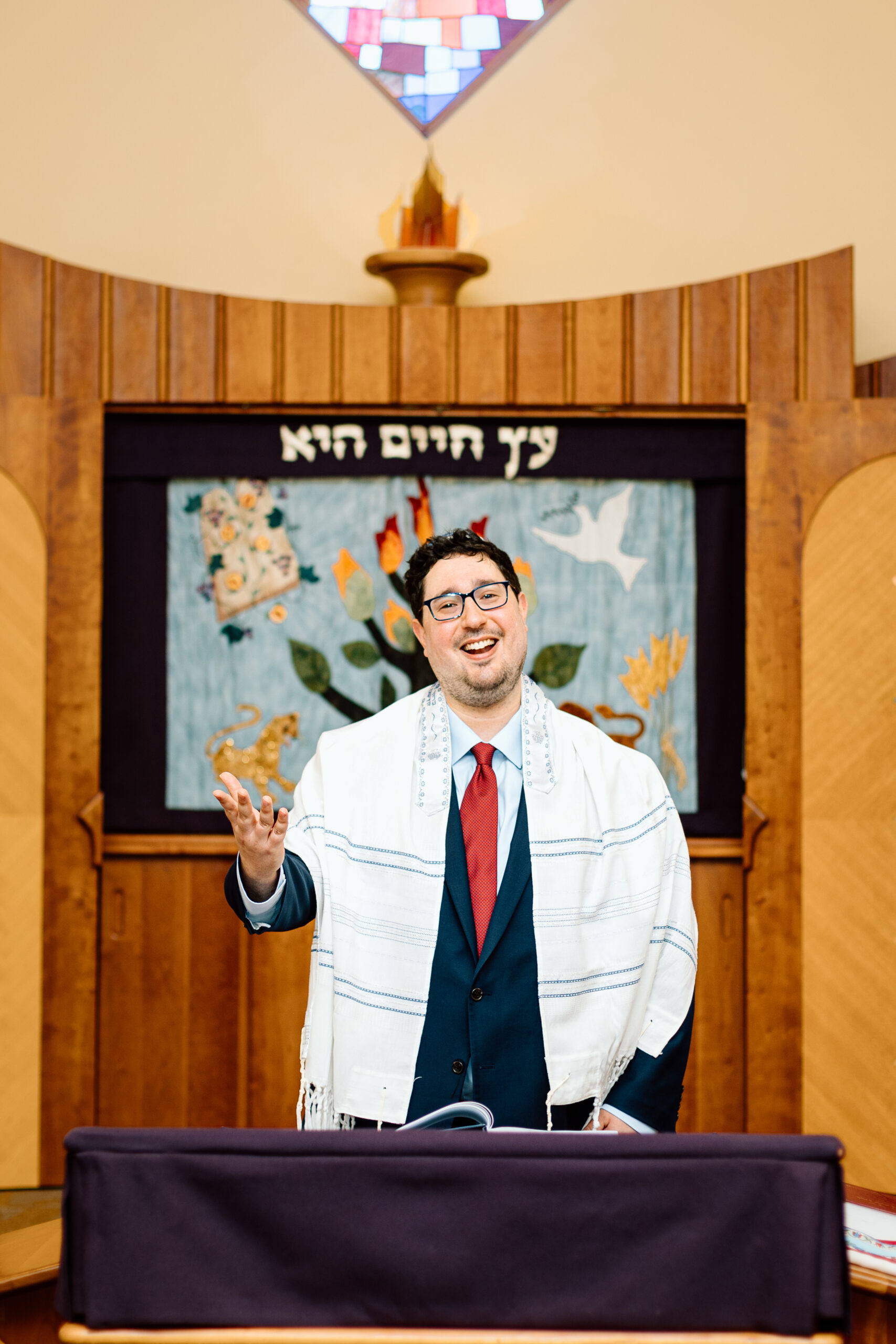
After working in law and politics, Rabbi Noach Lawrence decided to attend rabbinical school to education people on what wish texts say about the ethics of how people treat each other. Photo by Morgan Kraemer
By Kristen Senz
Since becoming religious leader of Congregation Beth Shalom last year, Rabbi Noach Lawrence has forged relationships in the community and facilitated conversations designed to bring together people with various perspectives on the war and suffering in the Middle East.
“The emotions were not always easy, but people responded with mutual respect, and they were able to see each other,” he says.
Micheal Weinman, a senior lecturer of political science and Jewish studies at Indiana University, took part in the discussions. “I really value his commitment to keeping all members of the community in communication, even when we have widely differing views on the war in Gaza and other issues of particular concern to Jewish Bloomingtonians like us.”
Before becoming a rabbi, Lawrence, 38, was a lawyer who served those who had endured modern atrocities. He worked in the UN International Criminal Tribunal for the Former Yugoslavia in the Hague and at the Israel Supreme Court. He also worked in the office of Sen. Richard Blumenthal, D-Connecticut, in Washington, D.C. “Throughout working in law and politics, I always felt that I was striving to fulfill the call of Jewish ethics,” he explains.
His decision to attend rabbinical school represented an evolution of his relationship with the power of classic texts. “Jewish texts and Jewish ethics have a lot to say about the ethics of how we treat each other, both in the private sphere and in the public sphere … and that’s something I’m passionate about helping people discover.”
A Boston-area native, Lawrence grew up visiting Ann Arbor, Michigan, where his uncle was a professor at the University of Michigan. In addition to his affinity for Midwest college towns and a desire to connect more deeply with nature, he was drawn to the unified approach to Judaism at Beth Shalom. The congregation hosts reform, conservative, and renewal services under one roof.
“I feel it’s a model for what North American Judaism needs and, really, what American society needs in this moment,” he says. “I’m proud of this model; it’s the kind of place where I wanted to be the rabbi.”Lawrence lives in Bloomington with his wife, Dr. Katie Roza, a palliative care clinician at IU Health Bloomington Hospital. Lawrence and Roza, who is deaf but hears with a powerful assistive device, often communicate using American Sign Language. They also share a common language as healers.
“She and I both talk a lot about what it means to strive for healing, because these are very broken times, and the need for healing is all-hands-on-deck.”