
BY CRAIG COLEY
While Indiana, like most states, struggles with an ongoing opioid crisis that officials predict will get worse before it gets better, there are groups trying to mitigate the damage. One of those is Bloomington-based Indiana Recovery Alliance (IRA), a nonprofit organization serving active and former drug users, with a focus on those who inject drugs.
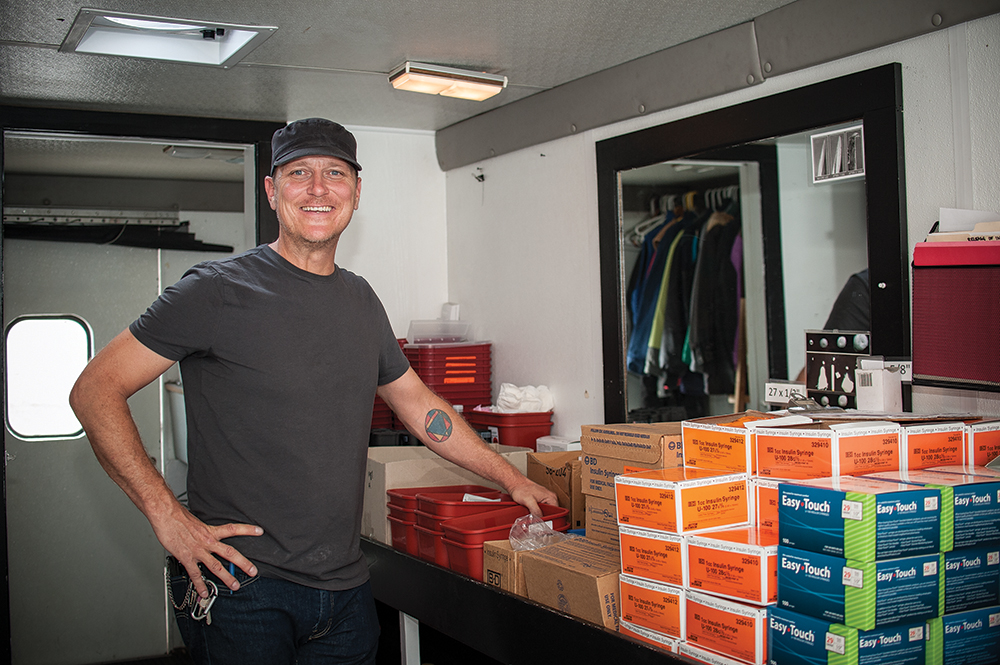
Operating on donations and a handful of grants, the IRA’s syringe exchange program (SEP) began in February 2016. Since then, more than 1,500 drug users have participated, and more than 300,000 syringes have been collected, most in Bloomington, though the program covers both Monroe and Lawrence counties. The IRA has also distributed about 7,000 doses of the overdose-reversing drug naloxone, and has received reports of 700 overdose reversals.
“If we prevent two cases of hepatitis C or one case of HIV, our entire year’s budget is justified,” says Chris Abert, the IRA’s director and only paid employee. The IRA website notes that for every $1 spent on prevention, $7 is saved in treatment costs. SEPs can decrease hepatitis C and HIV transmission by up to 80 percent.
“What we do is harm reduction,” Abert says. “We all engage in risky behaviors, and we take precautions to mitigate the negative consequences. It could be wearing a seatbelt. It could be a football player wearing protective equipment. It could be using clean syringes. It’s just that this is so stigmatized.”
Penny Caudill, administrator of the Monroe County Health Department, says the IRA is a vital link to a hard-to-reach population. A person who comes to the IRA for syringes is also offered hepatitis C and HIV test kits, information about health services, and referrals to organizations that support recovery and sober living.
Abert says the program is able to make these connections because it is nonjudgmental and noncoercive. Those involved in the syringe exchange program aren’t called “clients” but rather “participants.” Abert explains, “This isn’t charity. This is us looking out for each other. Because no one else is.”
On a Friday at noon, Abert parks the IRA van next to the Shalom Community Center on South Walnut. A young man steps up, and while Abert puts a box of 100 syringes into a bag, he asks what the man has done with his used ones.
“I brought them to the shop,” the man says, referring to the IRA’s office at 4th and Rogers streets. “But I have some other ones I found,” he says, and empties used syringes into a red bin inside the van. “I pick them up when I see them. I hate seeing them on the ground. I have kids. If you’re going to use drugs, fine, but you can pick up after yourself.”
The man took a risk carrying those syringes, possession of which could lead to a level six felony charge. He does have a card that identifies him as an IRA participant, and the Monroe County prosecutor has agreed not to charge participants simply for possession of syringes. But Bob Miller, the chief deputy prosecutor, says local police and sheriff’s deputies sometimes make arrests anyway, and the state police regularly do so.
“Our participants can’t keep getting arrested,” says Alicia Suarez, a medical sociologist on the faculty of DePauw University and president of the IRA’s board of directors. “It completely scares people, so then they don’t want to access our services. And there needs to be more places to put used needles in the downtown area.”
The IRA has offered to place secure-disposal boxes for syringes in parks and library bathrooms, but has been turned down. Monroe County Public Library Director Marilyn Wood acknowledges that people flush syringes down the toilets at the library, but says there is a greater concern that syringe disposal boxes would suggest that the library “appears to be encouraging people to use drugs.”
Caudill disagrees. “Anything we can do to increase the access for proper disposal is a benefit to the community and everybody,” she says. “So I don’t think there’s any harm at all to doing that.”
Suarez supports Caudill’s argument, saying, “There is the rhetoric that [harm reduction services, including public disposal boxes] are going to increase drug use. Research does not support that. We just don’t see that in the data.”
Abert says no one has told him they moved to Bloomington to access the IRA’s syringes. “The only thing this enables is people not to get HIV,” he says. “It enables them to not die. Dead people don’t recover.”