
by JANET MANDELSTAM
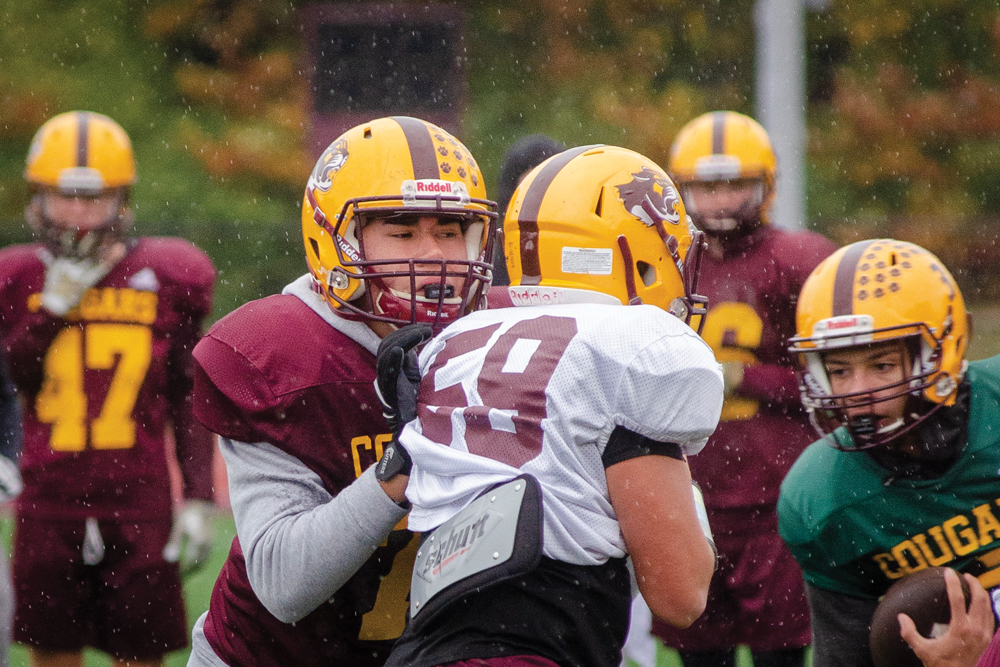
Concerns about concussions have led to questions about the safety of high school football. Now a team of researchers from Indiana University has set up shop at Bloomington High School North to study the impact of subconcussive hits in youthful football players over time.
Jesse Steinfeldt, associate professor of psychology, defines a subconcussive hit—a common occurrence in football—as “any sort of impact that hits the head but does not show symptoms of a concussion.”
When the IU team approached Bloomington North, “We had the opportunity to help pilot a study that could prove very valuable to the future of sports,” says Andy Hodson, the school’s athletic director. “This study could provide answers to many questions that people may have as their children are deciding to participate, or not, in a contact sport.”
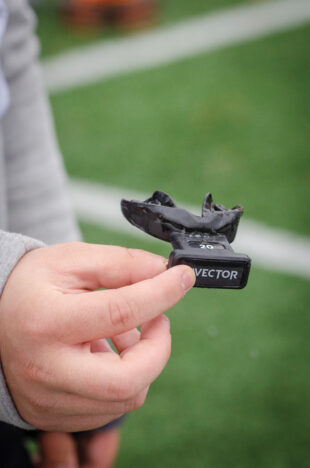
All members of the football squad had a pre-season MRI in July and will have a second test following the end of football season in December. The IU team is tracking eye movements and cognitive functioning and collecting blood and saliva samples. Additionally, the football players wear a computerized mouthguard that records the number, angle, and force of all hits to the head.
The school’s cross-country runners are serving as a control group. “Except for the mouthguards, these healthy, active athletes in a non-contact sport are being studied in the same way,” Steinfeldt says.
The IU researchers are led by Kei Kawata and Jon Macy, from the School of Public Health, and Steinfeldt. “The goal of the study,” Steinfeldt says, “is to provide data to influence policy.” He notes that youth baseball limits the number of pitches a player can throw. “Maybe our data will show that after a certain number of hits, a kid needs to rest a day or two and then is good to go again.”
The IU team has submitted a grant proposal to the National Institute of Health to expand the length and breadth of the study. If approved, the team would follow a group of players for four years at North, Bloomington South, Edgewood, and Mooresville high schools. “The schools are all on board and ready to go,” Steinfeldt says.
“Football is a great sport,” says Steinfeldt, a former college and professional player. “We can help football become safer by providing data-based guidelines for practice and games.”
Hodson agrees. “With all of the positive attributes that participation in sports can bring to a person’s life, making sure that we are doing it as safely as possible is paramount,” he says.