
BY SUSAN M. BRACKNEY
According to the Bureau of Labor Statistics, by 2026 the U.S. job market will have 3.5 million computer-related openings. High-paying software applications development and information security analysis jobs are among them. Nevertheless, women traditionally avoid the tech field.
“Women tend to have a mindset that tech skills are innate,” says Maureen Biggers, director of the Indiana University Center of Excellence for Women in Technology (CEWiT). “They think you either have them or you don’t, but that’s not true.”
Biggers says that not only do most girls and young women have little exposure to tech-specific pursuits in grades K through 12, there are also few positive female role models. “Women see themselves as not belonging in tech,” she says. One way that plays out is in the college courses they choose. For example, of the courses selected by IU freshmen during the fall 2015 semester, two tech courses were among the top 10 classes chosen by male students. By contrast, there were no tech classes in the top 50 classes selected by female students.
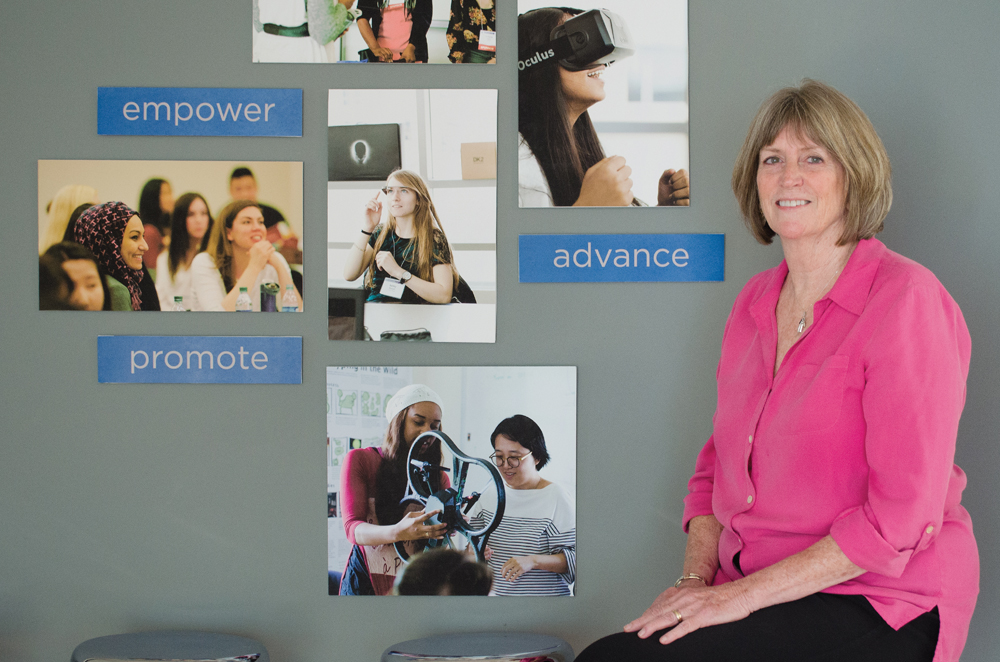
Since 2013, CEWiT has worked to close the gender gap by exposing women to a multitude of tech-related career paths and helping them strengthen tech skills. “We work with women who are technology majors and women who aren’t but who want to know more,” Biggers says.
CEWiT includes 3,400 students, from freshmen to Ph.D. candidates; 570 staff members; 750 faculty members; and 2,000 alumnae across multiple academic disciplines. The center offers mentorships, job shadowing, empowerment workshops, an annual conference, and 41 professional development internships. The Office of the Provost supplies 65 percent of the center’s budget; other IU entities make up the difference. CEWiT raises awareness around 28 of IU’s tech-focused degrees and programs. It recently launched a Corporate Affiliates Program to garner corporate sponsorships.
CEWiT also tries to mitigate the tech world’s uglier aspects. Biggers cites a study in which near-identical, tech-focused résumés were circulated to hundreds of people. “One of the résumés had a man’s name at the top, and the other had a woman’s name,” she says. The result? Regardless of their own gender, decision makers chose to “hire” the man—and were willing to pay him more.
To help alleviate those kinds of problems in the real world, CEWiT created the “Advocates & Allies for Equity” initiative, which supports male faculty-led workshops developed to raise awareness around unconscious bias. “They lead workshops with other male faculty members, so these men can be champions of equity when they go back into their departments,” Biggers explains.
Although tech skills boost women’s earning potential and marketability, the word still isn’t out. “Too many people are choosing not to learn tech skills because they don’t think they belong there or they don’t think it’s that important,” Biggers says. “But those skills give you an edge—they give you the edge.”